
Structures
Pillar of what once represented life downtown set to disappear
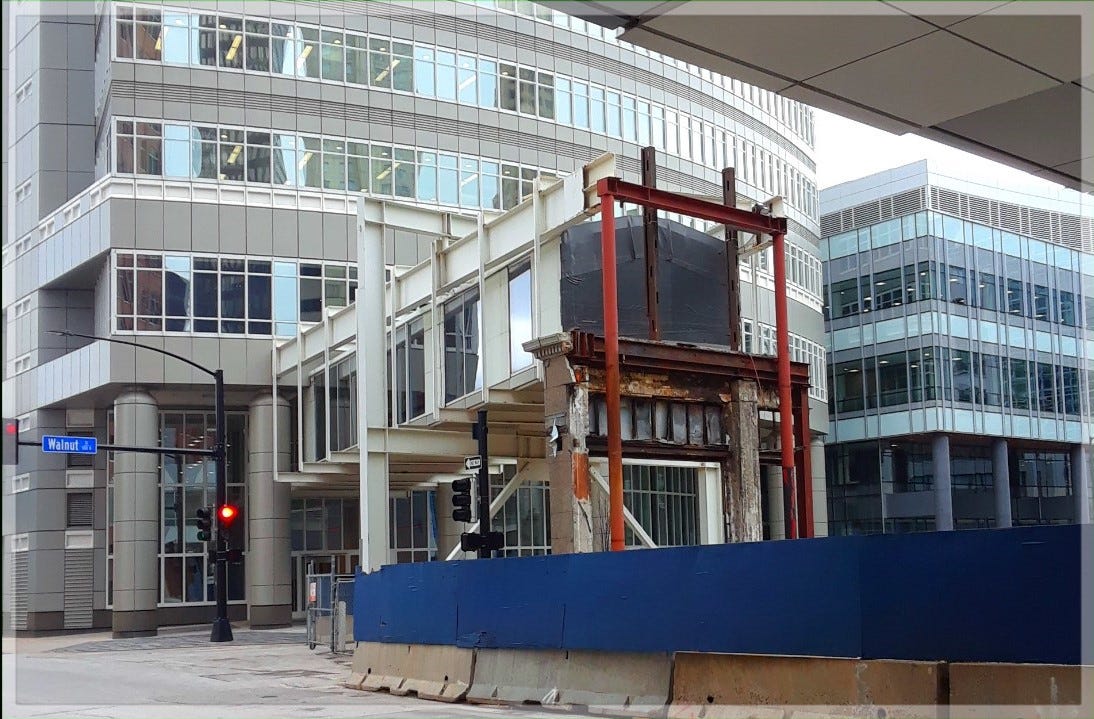
What remains of the burned Younkers Brothers Department Store at 713 Walnut St. is set to be toppled. The city of Des Moines is accepting bids to pull down the Skywalk Bridge 7C-7D over Walnut Street, including what is left of the Younkers building entry, still visible from the street and Skywalk.
The Des Moines City Council on April 19 approved the bridge removal and set a May 11 date to begin receiving bids and a June 14 hearing on the matter.
City Engineer Steven Naber told blocksdsm there are no plans to save that portion of the Younkers structure. Removal and disposal will be left to the contractor that wins the bid.
The Iowa Chapter of the American Institute of Architects helped explain what’s left, which is visible from the streets, sidewalks and Skywalk at the corner of 7th and Walnut.
Lyndley Kent, of Neumann Monson Architects, examined our image and told blocksdsm about the structure’s materials. The window frames are cast iron, including transom frames that once let natural light into the first floor of the store. There is structural steel as well as granite facing on the exterior side of the leftover wall, some terracotta water table (that feature deflects water running down the facade of a building, usually near the base of a wall) and concrete/plaster in the wall.
The building was designed by the local architectural firm of Liebbe, Nourse & Rasmusseen and was listed on the National Register of Historic Places in 2010.
The department store and flagship of the chain closed in 2005 after being in business at that location since 1899. The six-story structure was being renovated for apartments and retail shops when it burned March 29, 2014. (In 1924, it expanded to the adjacent Wilkins Building, which dates to 1909 and was damaged but not destroyed by the blaze, most likely because it was built with reinforced concrete. It now operates as Wilkins Building Apartments and its owner is Blackbird Investments.)
Blocksdsm will follow up with the winning bidder and plans for disposal of the ruins.
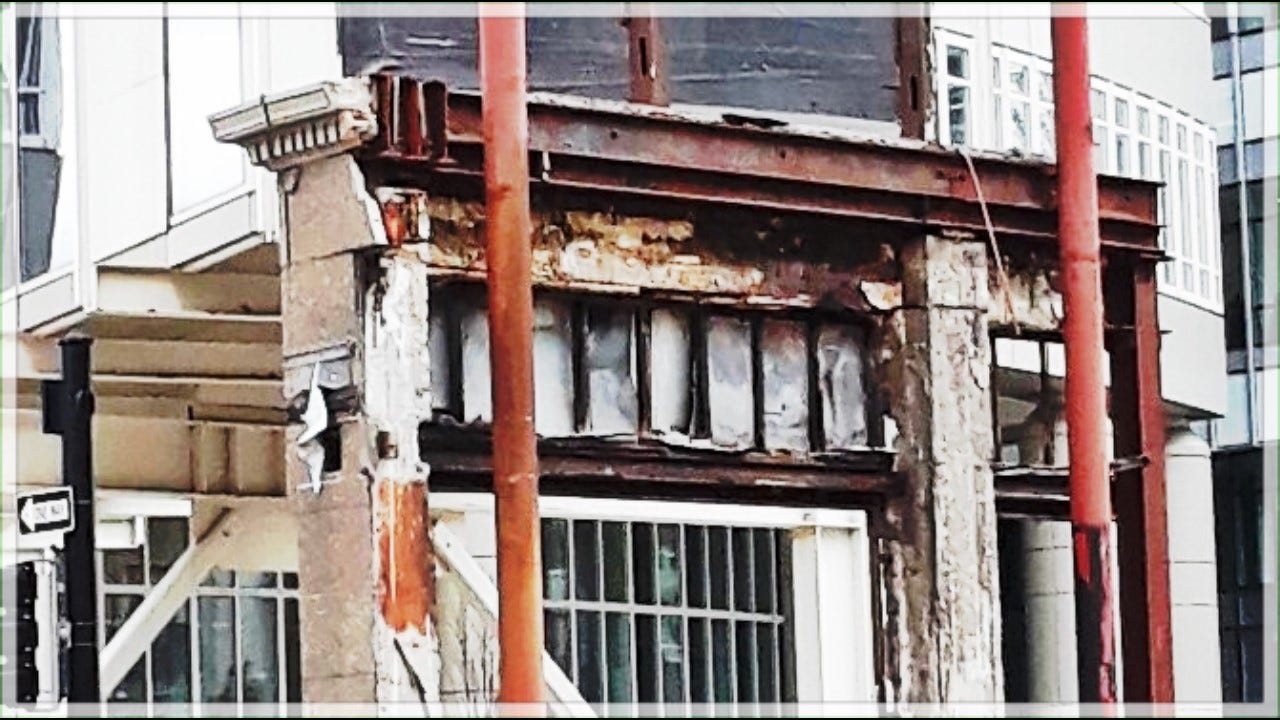
It’s a skeleton frame of stone, cast iron, plaster, and steel in downtown Des Moines. It’s what’s left of the Younkers building entry at 7th Avenue and Walnut. blocksdsm photo 04-21-2021
But it’s more than just steel and stone...
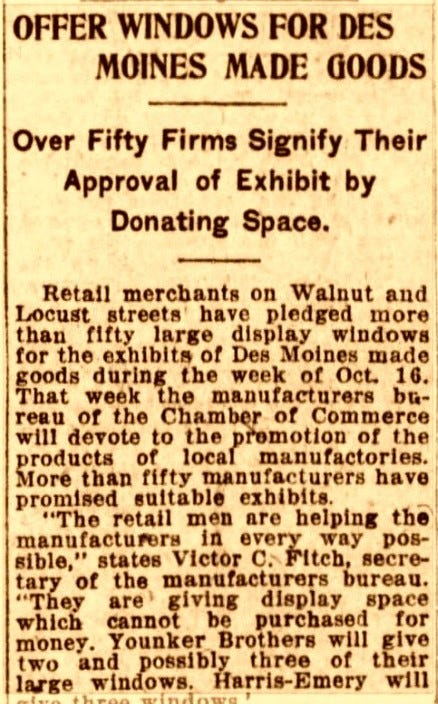
The department store educated, fed and entertained for more than 106 years. Society pages from The Des Moines Register detailed daily events at The Tea Room. News stories in 1916 described elaborate window displays lauding the area’s manufacturers. Another display in 1942 implored locals to buy war bonds, sold by the U.S. Treasury Department to finance the U.S. participation in World War II. It converted one display window on Walnut to a “Bond Shelter.” Volunteers sold bonds on the first floor.
And it once employed some who would later make headlines, including:
Eleanor Hoyt Brainerd, later a fashion writer and novelist (“In Vanity Fair”), was a clerk at the store in 1899. (Three of her novels were made into silent films; one “How Could You, Jean?” made in 1918, starred Mary Pickford.) Robert Ray, who served as Iowa’s governor from 1969 - 1983, had his first job at the store, as did Preston Daniels, the first African American elected to the Des Moines City Council and then elected mayor of Des Moines, serving 1997 - 2004.
Sources: American Association of Architects, Iowa chapter; City of Des Moines, The Des Moines Register archives, The Des Moines Tribune archives, “Younkers: The Friendly Store” by Vicki L. Ingram, Blackpast.org, Imdb.com
Blocksdsm shreads
Vicki L. Ingham penned a detailed history “Younkers: The Friendly Store,” published in 2016, and describes it as “more than a place to shop and eat … You could see fine arts exhibits and attend dances, lectures and cooking demonstrations, book clubs and charm school there.”
Some details from the book:
In the 1930s: The store introduced Theater Nights, where, for $1 per person, customers dined on a four-course meal, danced to a nine-piece orchestra and then received a movie ticket to one of the three theaters downtown. After the dinner crowd moved on at 9, rugs were rolled up to create a larger dancing space for a “late dance” for the younger crowd from 9:30 to midnight.
In 1939: The store installed the state’s first “electric stairs,” an escalator. The debut was broadcast live by radio and thousands lined up to take a ride.
In 1970: After racial unrest in Des Moines, the store hired a Black Santa (he worked when “white” Santa took breaks). It was part of a project with a local high school, so students could study customers’ reactions (most were pleasantly surprised). Santa was played by one of the school’s instructors, Sy Forrester. “I must have talked to about 1,000 kids, and not one said a thing about me being black,” he said.
1984: A 17-foot-tall replica of Michelangelo’s David statue was displayed at the store as part of “Festival Europa” promotion of fashions and home furnishings.
-30- (That means the end)
